If you think small construction jobs in Utah fly under the radar, you need to reconsider. Understanding how contractor licensing works Utah is not optional for anyone taking money to build, remodel, or repair. The rules are specific, the penalties are real, and the threshold that triggers mandatory licensing is lower than most people expect. This guide covers the license types, contractor license requirements Utah imposes, insurance and bonding obligations, the step-by-step Utah contractor license process, and recent legislative changes that make it easier for veterans to qualify.
Table of Contents
Key takeaways
| Point |
Details |
| $3,000 triggers licensing |
Any project where combined labor and materials exceed $3,000 legally requires a contractor license. |
| Four main license categories |
Utah issues General Building, Residential/Small Commercial, General Engineering, and Specialty licenses. |
| Insurance and bonding are mandatory |
You need general liability coverage, a surety bond, and workers’ compensation if you employ anyone. |
| Applications average 6-7 weeks |
Submit a complete package to Utah DOPL and plan for a six to seven week review window. |
| Local compliance is separate |
State licensure does not replace city or county permit and inspection requirements. |
How contractor licensing works in Utah
The
mandatory licensing threshold in Utah sits at $3,000 in combined labor and materials for a single project. Cross that line without a license and you are committing a class A misdemeanor. Do it again, and the charge escalates to a third-degree felony. Those are not administrative fines. Those are criminal records that follow you.
A few specific points worth knowing before you start any project:
- Projects under $3,000 do not require a state contractor license, but local permit requirements and workers’ compensation rules still apply if you have employees on the job.
- Verifying a contractor’s license status before signing any agreement is one of the most practical steps a client can take. Utah’s Division of Occupational and Professional Licensing (DOPL) maintains a public search tool for exactly this purpose.
- Homeowners who hire unlicensed contractors for work above the threshold lose certain legal protections and can face complications with insurance claims and resale inspections.
- Permit requirements from local building departments run in parallel with state licensing. Pulling a state license does not automatically satisfy city or county permit rules.
The practical takeaway is simple. If your project budget touches or exceeds $3,000, you need a license before the first nail goes in.
License types and qualification requirements
Utah does not issue one blanket contractor license. The
Utah contractor license process divides credentials into distinct classifications based on the type of work you perform.
The four primary categories are:
- General Building Contractor: Covers construction and renovation of commercial and residential structures. This is the broadest classification and typically requires the most documentation.
- Residential/Small Commercial Contractor: Applies to single-family homes, duplexes, and smaller commercial projects. Experience requirements are similar but scope is more defined.
- General Engineering Contractor: Covers infrastructure work such as grading, paving, and utilities.
- Specialty Contractor: Covers specific trades including electrical, plumbing, HVAC, concrete, and dozens of other defined categories.
For most classifications, you need to demonstrate at least two years of journey-level experience in your trade. That experience must be verifiable. DOPL reviewers will look at your documentation, so letters from employers or a personal history of self-employment contracts with tax records carry weight.
Exam requirements are non-negotiable for most applicants. You must pass a two-part exam covering Utah Business and Law as well as a trade-specific section. The exams are administered through a third-party provider, and you schedule them independently before submitting your final application.
Veterans have a meaningful advantage thanks to recent legislation. Under
SB 90, effective 2026, Utah accepts relevant military training and skills as equivalency credit toward licensing qualifications. This directly reduces the documentation burden for servicemembers transitioning into the trades.
Pro Tip: Start studying for the Business and Law exam before you gather your application documents. The exam is scheduled separately, and delays in scheduling can push your entire timeline back by weeks.
Insurance and bonding requirements
Getting licensed is not just about proving your skills. You need to demonstrate financial responsibility through insurance and bonding before DOPL will approve your application. Here is how the two main requirements compare:

| Requirement |
What it covers |
Minimum amount |
| General liability insurance |
Third-party property damage and bodily injury |
Varies by license type |
| Surety bond |
Financial guarantee of contract performance |
$15,000 for most general classifications |
| Workers’ compensation |
Employee injuries on the job |
Required if you have any employees |
The surety bond minimum of $15,000 is codified under Utah Code § 58-55-306. It protects clients if a contractor fails to complete work or violates licensing laws. A surety bond is not insurance for you. It is a guarantee to others that you will perform.
General liability coverage is a different story. The
state-required minimums vary by license type, but many commercial contracts require coverage significantly above those minimums. If you are bidding on commercial tenant improvement work or public projects, expect clients to ask for higher limits, often $1 million or more per occurrence.
Workers’ compensation kicks in the moment you hire employees. Utah’s Labor Commission enforces this separately from DOPL, and carrying workers’ comp is not optional once you have anyone on payroll.
Pro Tip: Get a certificate of insurance that names your client as an additional insured for commercial projects. This is a standard industry expectation, and arriving without it delays project starts.
Understanding that insurance and bonding differ by license type and contract size keeps you compliant and positions you competitively when bidding.
The step-by-step application process
Once you know your classification and have your experience documented, the actual Utah contractor license process follows a predictable sequence. Staying organized is the difference between a smooth six weeks and a frustrating four months.
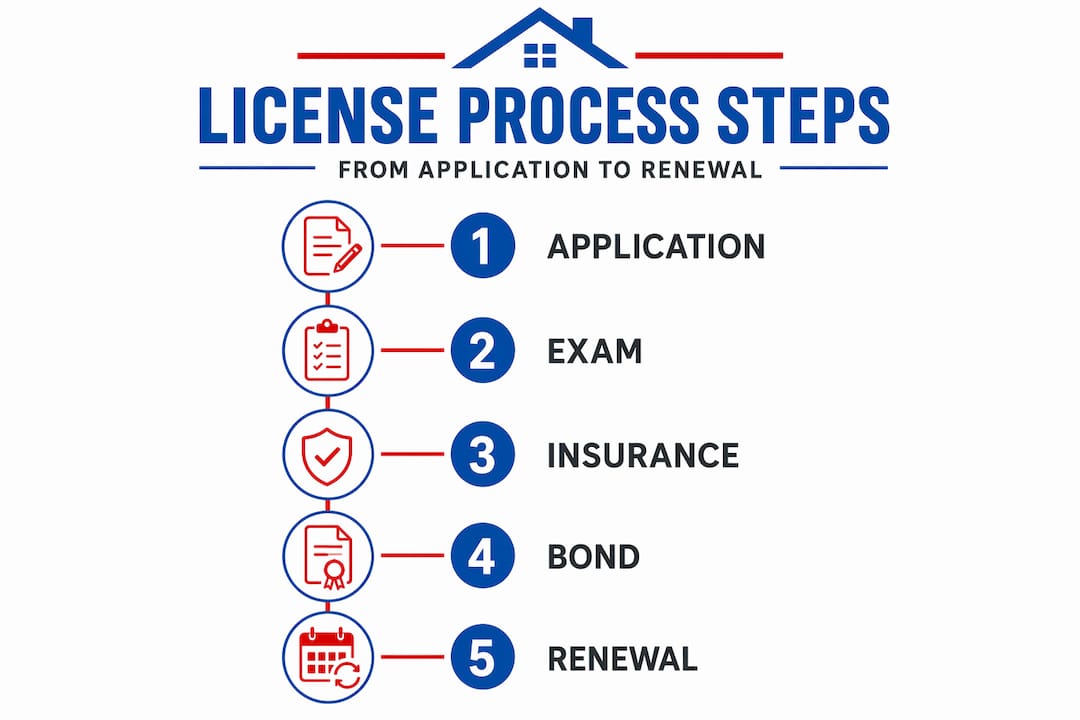
- Determine your license classification. Review DOPL’s classification list carefully. Applying under the wrong category is one of the most common causes of application rejection.
- Complete your pre-licensing education. Some classifications require formal coursework before you are eligible to sit for the exam.
- Schedule and pass your exams. The Business and Law exam and trade exam are both required. Pass both before submitting your application to avoid delays.
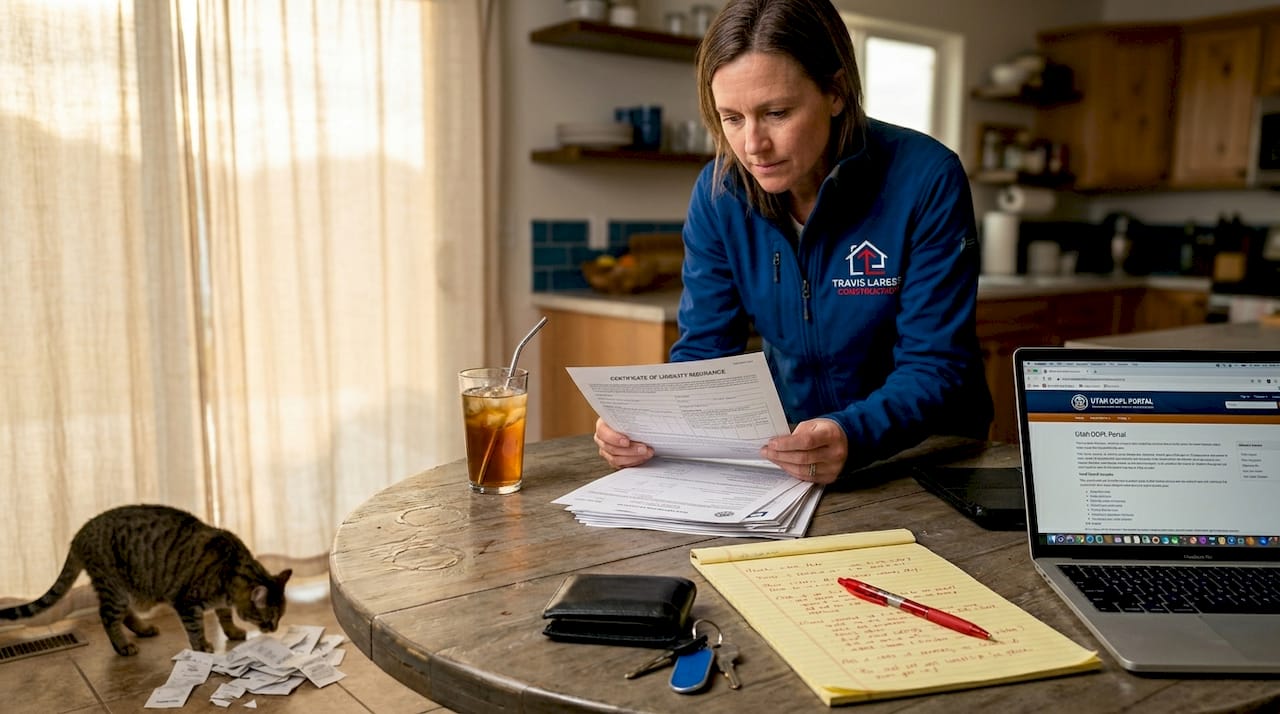
- Gather your documentation. You need proof of experience, exam scores, your insurance certificates, surety bond documentation, and any supporting employment records.
- Submit your application to Utah DOPL. Applications are submitted through DOPL’s online portal with all supporting documents and the required fees.
- Wait for processing. A complete application averages 6 to 7 weeks for review. If DOPL requests additional information, that clock resets. Missing documents are the number one cause of extended processing times.
- Receive your license and obtain your physical wallet card. Once approved, you are authorized to contract within your classification statewide, subject to local permit requirements.
For contractors already licensed in qualifying states, Utah offers
licensure by endorsement through reciprocity agreements with about 20 states. This can shorten the process significantly since some exam requirements may be waived.
Once licensed, you operate on a two-year renewal cycle.
Renewals require continuing education credits and payment of renewal fees. Let your license lapse and you face reinstatement fees on top of the standard renewal costs.
Local compliance beyond state licensing
A state contractor license from DOPL is not a permission slip to work anywhere in Utah without further compliance. Satisfying DOPL requirements gets you past the state threshold. It does not replace what local jurisdictions require.
Here is what that means in practice:
- Local building departments maintain independent authority over permits and inspections. Salt Lake City, Provo, and St. George all have their own permit offices with their own fee schedules and submittal requirements.
- Inspections are scheduled through local jurisdictions, not DOPL. Skipping a required inspection can void a certificate of occupancy.
- Workers’ compensation compliance is monitored by the Utah Labor Commission, which is a separate agency from DOPL entirely. Both must be satisfied simultaneously.
- Project type and location can affect which rules apply. A commercial remodel in one municipality may require additional fire marshal review that a residential project across the street does not.
The practical implication for project planning is real. Budget time and cost for local permit applications before your project start date, not after work begins.
My perspective on the licensing process
I have seen contractors and clients alike underestimate how layered Utah’s licensing system actually is. The state license gets most of the attention, and people stop there. What catches them is the local permit layer. I have watched otherwise well-prepared contractors delay project starts by two to three weeks because they did not pull a permit before mobilizing.
The documentation for your experience is another area where people cut corners and pay for it. DOPL reviewers take that part seriously. Vague letters from former employers or undocumented self-employment history gets flagged. Get letters on company letterhead with specific dates and roles before you ever schedule your exam.
On veterans using SB 90 provisions, my advice is to start that conversation with DOPL early and specifically. The law is new enough that the documentation process is still being standardized. Bring your military training records in full. Do not assume the reviewer knows what your MOS translates to in civilian trade terms. Explain it clearly.
Finally, carry more insurance than the minimum. The minimum gets you licensed. Real commercial and high-end residential clients will ask for more. Being at the minimum looks like a contractor who is operating at the margins, and that perception costs bids.
— Kaidden
Why Travis Larsen Construction is the right partner for your Utah project
When you understand contractor licensing regulations Utah enforces, you realize how much trust is built on a license number. At
Travis Larsen Construction, every project we deliver is backed by full compliance with Utah’s licensing and insurance requirements. We specialize in high-end custom homes, commercial builds, tenant improvement projects, and business remodels across Utah.
Our clients do not have to manage the compliance puzzle themselves. We carry the credentials, the coverage, and the documentation that protects you throughout every phase of construction. If you are planning a project and want a contractor who understands how the licensing and permitting process works from the inside, contact our team and let us walk you through what your project requires from day one.
FAQ
What is the contractor licensing threshold in Utah?
Any project with combined labor and materials exceeding $3,000 legally requires a contractor license in Utah. Working above that threshold without a license is a class A misdemeanor.
How long does the Utah contractor license process take?
A complete application submitted to Utah DOPL typically takes 6 to 7 weeks to process. Missing documents or requests for additional information can extend that timeline significantly.
What exams are required for a Utah contractor license?
Most applicants must pass two exams: the Utah Business and Law exam and a trade-specific exam. Both are administered through a third-party provider and must be completed before your application is finalized.
Does a Utah contractor license cover local permits?
No. A state contractor license from DOPL does not replace local building permits or inspections. Each city and county operates its own permitting process independently of the state licensing system.
Can out-of-state contractors get a Utah license more quickly?
Yes. Utah offers licensure by endorsement for contractors already licensed in approximately 20 qualifying states. This reciprocity arrangement can waive certain exam requirements and shorten the overall licensing timeline.
Recommended
 Our clients do not have to manage the compliance puzzle themselves. We carry the credentials, the coverage, and the documentation that protects you throughout every phase of construction. If you are planning a project and want a contractor who understands how the licensing and permitting process works from the inside, contact our team and let us walk you through what your project requires from day one.