
A commercial general contractor (GC) is the single point of accountability for every phase of a commercial construction project, from initial permitting through final occupancy. Where other construction roles advise or observe, the GC owns the outcome. On a typical commercial build, the GC coordinates 15 to 25 specialized subcontractors, manages compliance with International Building Code standards and OSHA regulations, and holds the budget and schedule together under one contract. For business owners and developers, understanding this role is the difference between a project that delivers on time and one that unravels in costly delays.
What does a commercial general contractor actually do?
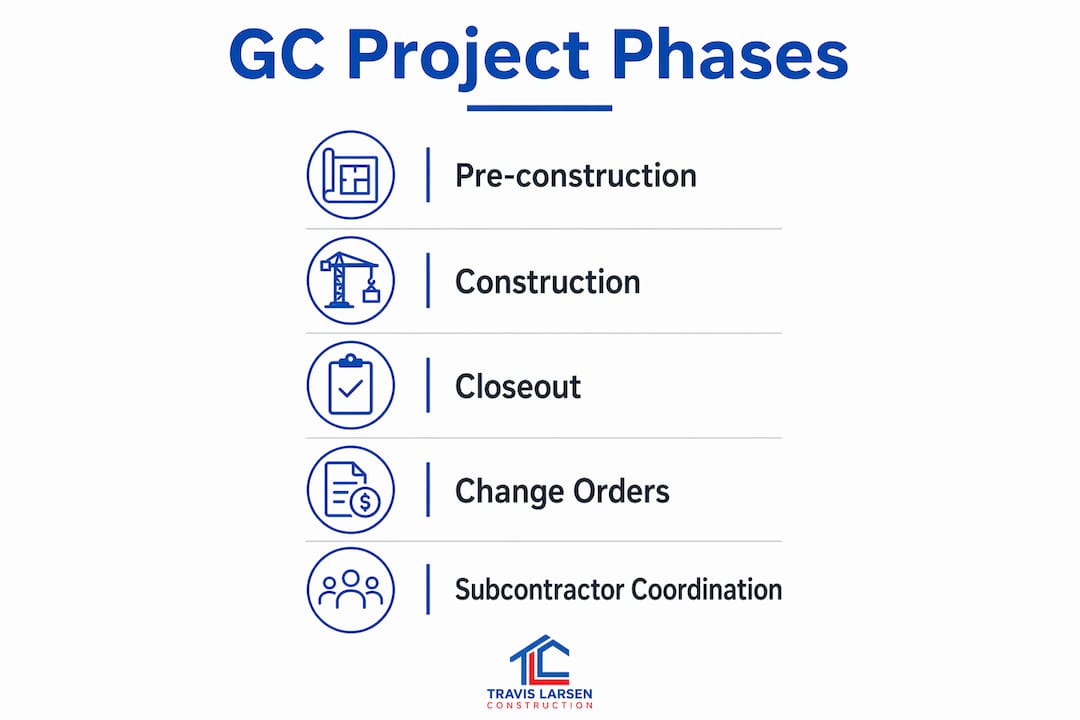
The role of general contractor in commercial construction spans three distinct phases, and each one carries specific obligations that protect the owner’s investment.
Phase 1: Pre-construction
Before a single shovel breaks ground, the GC reviews architectural drawings for constructability, prepares detailed cost estimates, and pulls the required permits from local authorities. This phase also includes value engineering, where the GC identifies materials or methods that meet design intent at lower cost. Skipping this step is where many owners lose money before construction even begins.

Phase 2: Construction execution
During active construction, the GC’s commercial contractor responsibilities include daily on-site supervision, subcontractor scheduling using the critical path method (CPM), and enforcing OSHA 29 CFR Part 1926 safety standards across all trades. CPM scheduling maps every task dependency so a delay in framing, for example, triggers an automatic reschedule of electrical rough-in. The GC also manages change orders, which are written amendments to the contract scope that affect cost or schedule.
Phase 3: Project closeout
Closeout is where inexperienced GCs lose credibility fast. This phase includes completing the punch list (a documented list of unfinished or deficient items), coordinating final inspections with the authority having jurisdiction, securing the certificate of occupancy, and delivering warranties for all installed systems. Transparent financial reporting showing actual versus estimated costs at closeout is what separates professional GCs from those who disappear after the last nail.
Pro Tip: Request a detailed change order log at every project meeting. Uncontrolled change orders are the single most common cause of commercial budget overruns, and a professional GC tracks every one in writing.
How do GCs differ from construction managers and owner’s reps?
These three roles are frequently confused, and the confusion costs owners money. Here is how they actually differ.
| Role | Contract type | Who bears risk | Primary obligation |
|---|---|---|---|
| General contractor | Lump sum or GMP | GC bears construction risk | Deliver the project per contract |
| Construction manager (CM) | Fee-based, 5% to 15% of project cost | Owner bears construction risk | Advise and manage on owner’s behalf |
| Owner’s representative | Flat fee or hourly | Owner bears all risk | Represent owner’s interests only |
Construction managers charge a fee between 5% and 15% of total project costs and operate with open-book transparency, meaning the owner sees every subcontractor bid and invoice. A GC working under a lump sum contract includes markups on subcontractor work within a fixed price. That markup is the GC’s compensation for absorbing schedule and cost risk. Neither model is universally better. The right choice depends on project complexity, owner capacity, and risk tolerance.
The owner’s representative sits outside both roles entirely. This person or firm represents only the owner’s interests, reviewing GC performance, flagging contract issues, and reporting to ownership without any financial stake in construction outcomes. On very large projects, separating the GC and CM roles maintains objectivity and reduces the risk of self-serving change orders.
Pro Tip: For commercial projects over $5 million, consider hiring an owner’s rep alongside your GC. The fee is typically 1% to 2% of project cost and often saves multiples of that in avoided disputes and scope creep.
Why is a qualified GC critical for risk and compliance on large projects?
Managing a large commercial build without a qualified GC is not just difficult. It is a liability exposure most business owners are not equipped to absorb.
The GC’s risk management function covers several layers that owners rarely anticipate:
- Regulatory compliance: Commercial projects must meet International Building Code requirements, ADA accessibility standards, local fire codes, and zoning ordinances. The GC is contractually responsible for code compliance on every system installed.
- Safety enforcement: OSHA violations on a commercial site can result in fines exceeding $15,000 per citation. The GC manages safety programs, conducts toolbox talks, and maintains incident logs across all subcontractors.
- Subcontractor coordination: Large projects require multiple specialized subcontractors to leverage trade expertise and maintain schedule efficiency. Without a GC orchestrating sequencing, trade conflicts (such as mechanical and electrical work competing for the same ceiling space) cause expensive rework.
- Financial protection: The GC manages lien waivers from every subcontractor and supplier, protecting the owner’s property from mechanics’ liens filed by unpaid trades.
“A primary reason for hiring a commercial GC is risk mitigation; the GC assumes responsibility for regulatory compliance and logistics that can cause costly delays and liabilities.”
Some owners attempt multi-prime contracting, where they hire trade specialists directly to avoid GC markups. Skipping the GC shifts all scheduling coordination and risk management onto the owner, which routinely overwhelms teams without construction expertise. The markup savings rarely offset the cost of delays, defects, and disputes that follow.
How to hire and manage a commercial general contractor effectively
Selecting the right GC is as important as any design decision you make. The following criteria are non-negotiable when evaluating candidates.
- Active state licensing and insurance: Verify the GC holds a current contractor’s license and carries general liability insurance plus workers’ compensation. Ask for certificates of insurance naming your entity as an additional insured.
- Relevant project experience: A GC with a strong track record in office builds may not be the right fit for a restaurant or industrial facility. Proven experience in your specific project type matters more than total years in business.
- Subcontractor network quality: Ask which subcontractors the GC plans to use and whether those relationships are long-standing. A GC with a vetted, reliable subcontractor network delivers better quality and fewer surprises than one assembling a new team for every project.
- Transparent pricing practices: Request an itemized bid, not a single lump sum number. Detailed line items let you compare bids accurately and identify where one GC is cutting corners.
- Early engagement: Bringing a GC on board during schematic design allows for value engineering that prevents costly constructability issues before they are locked into drawings. Owners who wait until construction documents are complete lose this advantage entirely.
Once you have selected a GC, active oversight matters. Schedule weekly progress meetings, require written change order approval before any scope changes proceed, and request monthly budget reports showing actual versus estimated costs. The GC manages the project. You manage the GC.
Key takeaways
A commercial general contractor is the single professional who absorbs construction risk, coordinates all trades, and delivers a code-compliant building on your behalf.
| Point | Details |
|---|---|
| GC as single point of accountability | The GC owns schedule, budget, compliance, and quality across all 15 to 25 subcontractors. |
| Three-phase responsibility | Pre-construction, construction execution, and closeout each carry distinct GC obligations that protect the owner. |
| GC versus CM distinction | GCs bear construction risk under fixed contracts; CMs advise owners for a fee of 5% to 15% of project cost. |
| Risk mitigation is the core value | Without a GC, owners absorb OSHA liability, lien exposure, and subcontractor coordination failures directly. |
| Early engagement saves money | Hiring a GC during design allows value engineering that prevents expensive constructability errors later. |
What I have learned about GCs that most articles skip
I have watched owners make the same mistake repeatedly: they treat the GC selection as a procurement exercise and pick the lowest bid. That logic works for buying office supplies. It does not work for a $3 million retail buildout.
The real tension in commercial contracting is financial. GC incentives push toward margin preservation, which means change orders are not just administrative paperwork. They are a revenue mechanism. A GC who bids low to win the job and then recovers margin through change orders is a pattern I have seen play out on projects of every size. The defense is not distrust. It is documentation. A detailed scope of work, a signed change order process in the contract, and a monthly budget reconciliation remove most of the leverage a GC would otherwise have.
The other thing most articles miss is the value of contractor experience in your specific building type. A GC who has built 20 restaurants understands hood suppression systems, grease trap permitting, and health department inspections in a way that a generalist never will. That knowledge prevents delays that a low bid cannot compensate for. Hire for fit, not just price.
— Kaidden
See what Travis Larsen Construction delivers on commercial projects

Travis Larsen Construction brings over 25 years of commercial general contracting experience to retail, office, industrial, and restaurant projects across Iron County. Every project runs under a strict budget and timeline commitment, with in-house design support and transparent pricing built into the process from day one. Clients get a single point of contact who knows the project as well as they do, not a rotating cast of project managers. If you are planning a commercial build and want a GC who treats your budget like their own, explore Travis Larsen’s commercial services to see current project examples and request a consultation.
FAQ
What is the role of a general contractor on a commercial project?
A commercial general contractor manages the entire construction lifecycle, including permitting, subcontractor coordination, scheduling, safety compliance, and project closeout. The GC serves as the single point of accountability between the owner and all construction trades.
How many subcontractors does a commercial GC typically manage?
A typical commercial project involves 15 to 25 subcontractor companies coordinated by the GC, covering trades such as electrical, mechanical, plumbing, framing, and finishes.
What is the difference between a general contractor and a construction manager?
A general contractor holds a fixed-price or guaranteed maximum price contract and bears construction risk directly. A construction manager works on a fee basis, typically 5% to 15% of project cost, and advises the owner without assuming financial risk for construction outcomes.
When should I hire a GC for a commercial project?
Hire the GC during the schematic design phase, not after construction documents are complete. Early engagement allows value engineering that controls costs and prevents design decisions that are expensive to build.
What qualifications should I verify before hiring a commercial GC?
Verify active state licensing, general liability insurance, workers’ compensation coverage, and project-specific experience. Request references from owners of comparable project types and ask for an itemized bid to assess pricing transparency.