
Building a custom home in Southern Utah is one of the most significant financial commitments you will ever make. Without a solid custom home budget planning checklist, costs can spiral before the foundation is even poured. Southern Utah adds its own wrinkle to the equation: rocky desert terrain, municipality-specific impact fees, and extreme temperature swings all affect what you will actually spend. This article gives you a structured, locally informed checklist you can use from day one, plus the knowledge to avoid the mistakes that derail even well-intentioned budgets.
Table of Contents
- Key Takeaways
- 1. Your custom home budget planning checklist starts here
- 2. Land and lot costs: the line item people underestimate
- 3. Permit and impact fees: know what Southern Utah charges
- 4. Architectural, engineering, and design fees
- 5. Step-by-step hard cost checklist items
- 6. Soft cost checklist: the items most buyers miss
- 7. Locking in finishes early: why it matters for your budget
- 8. Comparing budgeting tools: spreadsheets, apps, and builder-led approaches
- 9. Common budget mistakes Southern Utah homeowners make
- My take on budgeting for a custom home in Southern Utah
- Build smarter with Travis Larsen Construction by your side
- FAQ
Key Takeaways
| Point | Details |
|---|---|
| Separate hard and soft costs | Treating hard and soft costs as one lump sum leads to budget shortfalls; track them independently from the start. |
| Build in a contingency reserve | Start with 15% contingency pre-construction and adjust down as plans lock in and contracts are signed. |
| Know your local fees upfront | Southern Utah permit and impact fees vary widely by municipality and can add $40,000 or more to soft costs. |
| Lock in finishes early | Delayed finish selections cause cabinet and countertop lead times to push your schedule and inflate costs. |
| Update your budget regularly | A budget is a living document; review and revise it at every major construction milestone. |
1. Your custom home budget planning checklist starts here
Before you build a single line item into a spreadsheet, you need to understand what a custom home budget actually contains. Most people think in terms of construction costs, and stop there. A true home cost management plan separates your total spend into three distinct buckets: hard costs, soft costs, and contingency reserves.
Hard costs are everything physical. Foundation, framing, roofing, plumbing, electrical, HVAC, cabinetry, flooring, paint. These are the line items most builders quote when you ask for a price per square foot. In Southern Utah, construction costs average $150 to $200 per square foot for standard finishes, climbing to $200 to $250 for mid-grade selections, and exceeding $350 for luxury or architecturally complex builds.
Soft costs are everything else: architectural and engineering fees, permits, surveys, geotechnical reports, legal fees, and financing costs. Soft costs typically represent 8% to 15% of your total construction budget. Skip them in your early planning and you will be hunting for money before the framing crew shows up.
Contingency reserves sit in a third column by themselves. A reserve is not a slush fund. It is a calculated buffer for conditions you cannot predict yet, and starting it at 15% of total hard costs during pre-construction is the standard recommended by experienced builders.
2. Land and lot costs: the line item people underestimate
Your custom budgeting checklist should include land as a separate, detailed line item. In Southern Utah, lot prices swing dramatically depending on whether you are in St. George, Cedar City, or a more rural part of Iron County. Land can add $75,000 to over $500,000 to your total project cost before a single permit is pulled.
Beyond the purchase price, factor in lot preparation. Does the parcel have utilities stubbed to the property line, or will you extend water, sewer, and power from the road? Each utility extension adds cost that many buyers overlook until they are already under contract.
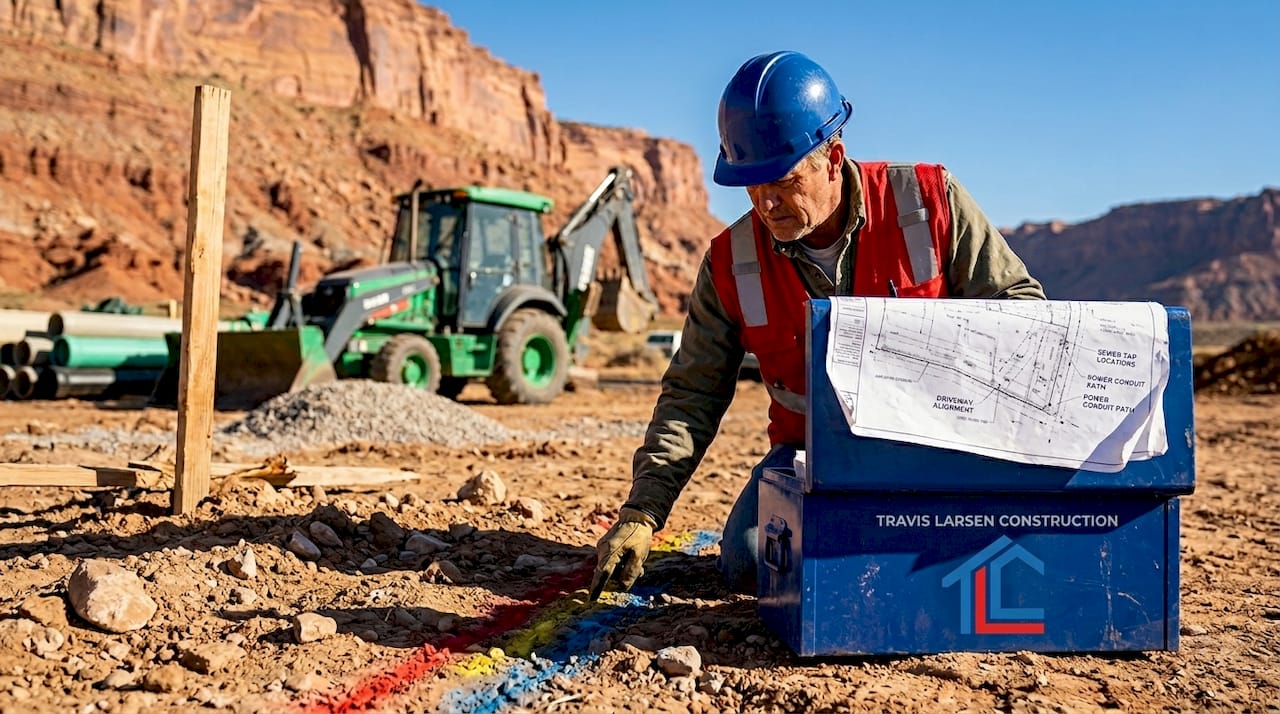
Pro Tip: Order a geotechnical report before you finalize your land purchase. In Southern Utah, rocky soil and caliche layers are common. Site conditions like poor soil bearing or rock can add $20,000 to $50,000 or more to excavation and foundation work. Knowing this upfront protects your budget and your negotiating position on the land price.
3. Permit and impact fees: know what Southern Utah charges
Permits are not just paperwork. They are a real budget line item that varies more than most homeowners expect. Building permits in St. George can range from $25 to $5,000 depending on project type and valuation. Add impact fees on top of that, and the number grows significantly.
Impact fees in Southern Utah municipalities can run $15,000 to $40,000 or more depending on where you build. Cedar City, Enoch, and unincorporated Iron County each have their own fee schedules. Call the local building department early in your planning process and get fee estimates in writing. Build those numbers into your home budget planner before you finalize your design.
This step alone separates prepared buyers from buyers who panic at closing on their construction loan.
4. Architectural, engineering, and design fees
Your house budget guide is incomplete without a full accounting of professional fees. Architecture and engineering costs are real expenses that belong in the budget before construction starts. Most custom home architects charge either a percentage of construction cost (typically 5% to 10%) or a flat fee negotiated at the start of the engagement.
Engineering fees for structural, civil, and geotechnical work add another layer. In Southern Utah, where soil and terrain vary block by block in some areas, you may need a structural engineer to sign off on your foundation design in addition to your civil engineer handling grading and drainage.
Do not assume these fees are embedded in your builder’s quote. They usually are not, unless you are working with a firm that offers true in-house design-build services.
5. Step-by-step hard cost checklist items
This is the core of your financial planning for a home build. Work through each category and get a real number or a reasonable estimate before you commit to a total budget.
- Site work and grading: Clearing, grading, excavation, and soil compaction. Get a soils report first.
- Foundation: Slab, stem wall, or full basement. Foundation type affects cost significantly in rocky terrain.
- Framing: Labor and material costs for structural framing, including roof structure and sheathing.
- Roofing: Material selection (tile is common in Southern Utah for heat reflection) and labor.
- Windows and exterior doors: These are high-ticket items. Get actual quotes, not allowances.
- Plumbing rough-in and finish: Separate the rough-in phase from finish fixtures, which are often allowance-based.
- Electrical rough-in and finish: Same logic applies. Lighting selections especially vary in cost.
- HVAC: Southern Utah’s extreme heat requires properly sized systems. Do not let this be a low-ball estimate.
- Insulation: Climate-driven design means adequate insulation is non-negotiable for long-term cost control.
- Interior finishes: Cabinets, countertops, flooring, tile, and paint. These are where budgets most commonly bleed over.
Pro Tip: Wherever your builder uses an allowance instead of a fixed quote, research the actual market price before signing your contract. Allowances are placeholders; if you exceed them, you pay the difference out of pocket. Demand itemized pricing on high-cost categories.
6. Soft cost checklist: the items most buyers miss
Budgeting for building a house means accounting for every dollar that flows out, not just the dollars that go into physical construction. Below are the soft cost items that belong in every custom budgeting checklist:
- Architectural and design fees
- Structural and civil engineering
- Geotechnical (soils) report
- Land survey and legal description
- Permit fees and plan review fees
- Impact fees (water, sewer, traffic)
- Construction loan origination and interest
- Builder’s risk insurance during construction
- HOA application fees (if applicable)
- Legal fees for contract review and title work
Many of these costs hit before construction starts. Plan your cash flow accordingly.
7. Locking in finishes early: why it matters for your budget
One of the most predictable ways custom home budgets go over is delayed finish selection. Cabinet orders take 8 to 12 weeks. Countertops, tile, and specialty fixtures have similar lead times. When selections are delayed, your construction crew sits idle or moves to the next job, and your schedule and costs both expand.
The financial impact is not just the price of the materials. It is the cost of schedule gaps, extended construction loan interest, and the psychological pressure that leads to rushed decisions and expensive changes. Your personalized home expenses plan should include a deadline for every major finish selection, tied to your construction schedule milestones.
Lock in your cabinets and countertops before framing is complete. Make all tile and flooring decisions before rough-in finishes. Treat your selections schedule as a financial document, not just a design task.
8. Comparing budgeting tools: spreadsheets, apps, and builder-led approaches
| Tool | Best for | Watch out for |
|---|---|---|
| DIY spreadsheet | Early-stage cost modeling and tracking | Version control and formula errors can mislead you |
| Budgeting app (e.g., CoConstruct) | Tracking live costs against budget during build | Requires discipline to keep updated; learning curve |
| Builder-provided cost summary | Understanding your contract in detail | May lack transparency on markup and allowances |
| Professional estimator | Pre-contract validation of your budget | Adds upfront cost, but catches errors before they multiply |
The right approach depends on how far along you are and how much detail you need. In the early planning phase, a spreadsheet template organized by hard costs, soft costs, and contingency works well. Once you have a builder and a contract, aligning your draw schedule with actual construction milestones becomes the priority.
Most construction loans release funds in three to five draws tied to verified milestones like foundation, framing, rough-in, and finishes. Your home budget planner should map directly to these draws so you always know where you stand against your loan balance.
9. Common budget mistakes Southern Utah homeowners make
The most expensive errors in custom home builds are not dramatic. They are quiet, accumulating mistakes that only become obvious when you are already deep into construction.
- Skipping or undersizing contingency: A contingency is not optional. Starting at 15% and adjusting down as unknowns resolve is the proven approach.
- Treating allowances as firm prices: They are not. Allowances are your builder’s placeholder, not a commitment. Always verify what your selections will actually cost before signing.
- Ignoring soft costs in early planning: Leaving $40,000 to $55,000 in professional fees and permit costs out of your initial budget is a budget-busting omission.
- Underestimating site challenges: Southern Utah’s rocky desert terrain can surprise even experienced builders. Order a soils report early.
- Not updating the budget as the project progresses: Budgeting is not static. Review your numbers at every milestone and reconcile any change orders immediately.
The biggest budgeting failures consistently trace back to missing the clear separation between hard costs, soft costs, and contingency, and a lack of pricing transparency between builder and client.
My take on budgeting for a custom home in Southern Utah
I have watched homeowners approach their budget as a one-time exercise. They build a spreadsheet, get a contractor quote, and consider the financial planning done. That thinking costs people real money.
What I have learned is that your budget is a decision-making tool throughout the entire project. Every time a change order lands on your desk, every time a finish selection comes in over allowance, you need to measure that against your current budget state, not the one you built six months ago. The builders who stay on budget are the ones who treat that document as a living record.
The other thing I will say directly: local knowledge matters more than any spreadsheet template. Understanding how Southern Utah permit fees, soil conditions, and climate requirements actually behave in practice is knowledge you cannot get from a generic house budget guide. A builder who has worked in Iron County for years knows what a rocky lot in Enoch costs compared to a prepared lot in a St. George subdivision. That knowledge changes your numbers.
My top checklist recommendation? Spend the first month on pre-construction planning before you commit to anything. Order the soils report. Get actual permit fee estimates from the municipality. Lock your design intent before your architect starts drawings. You will save more time and money in that first month than at any other point in the project.
— Kaidden
Build smarter with Travis Larsen Construction by your side
Putting together a detailed custom home budget planning checklist is the right move. Having a builder who honors it is what makes the difference. Travis Larsen Construction brings over 25 years of custom home expertise to Iron County and Southern Utah, with an in-house design and build process built specifically to keep your project on budget and on schedule. Their team walks you through every line item, from permit fees to finish selections, so there are no surprises. If you are ready to build with a team that treats your budget as seriously as you do, visit Travis Larsen Construction to start the conversation.
FAQ
What should a custom home budget planning checklist include?
A thorough checklist covers hard costs (site work, foundation, framing, systems, finishes), soft costs (architectural fees, permits, impact fees, financing), a contingency reserve of 10% to 15%, and land acquisition. Each category should carry actual quotes or verified estimates, not guesses.
How much does it cost to build a custom home in Southern Utah?
Construction costs in Southern Utah average $150 to $350 per square foot depending on finish level and design complexity, plus land costs that can range from $75,000 to over $500,000.
What contingency reserve should I budget for a custom home?
Start your contingency at 15% of total hard construction costs during pre-construction, then adjust it down toward 10% or lower as your plans finalize and fixed-price contracts are signed.
What are soft costs in a custom home budget?
Soft costs include all non-construction expenses such as architectural and engineering fees, permits, impact fees, surveys, legal costs, and construction loan interest. In Southern Utah, these typically represent 8% to 15% of your total construction budget.
Why do finish selections affect my budget timeline?
Selecting finishes late causes lead-time delays that stall construction and extend your loan period. Cabinet and countertop orders require up to 12 weeks of lead time, meaning every week of delay costs you both schedule time and construction loan interest.