When a property owner chooses a contractor based on the lowest bid, they’re often making the most expensive decision of the project. The reality is that why contractor experience matters goes far beyond credentials on a website. Inexperienced contractors leave money on the table through rework, mismanaged change orders, permit delays, and poor communication. The good news is that every one of those risks is measurable, and understanding them gives you the leverage to make a smarter hiring decision before the first shovel hits the ground.
Table of Contents
Key Takeaways
| Point |
Details |
| Rework is underreported |
Field rework costs average 0.38% to 0.76% of contract value, and experienced contractors catch defects early to prevent it. |
| Experience controls cost risk |
Seasoned contractors manage material escalation, change orders, and estimating gaps that routinely blow project budgets. |
| Permits and approvals take expertise |
Approval bottlenecks can add weeks and millions in costs. Experience accelerates these processes. |
| Quality is visible to trained eyes |
Licensed contractors can identify subcontractor workmanship issues that untrained project managers simply miss. |
| Communication tools multiply experience |
CRM platforms like Job Tread give experienced teams a structured way to keep clients and subcontractors aligned. |
Why contractor experience matters when rework happens
Rework is the silent budget killer in construction. Most property owners never see it clearly on an invoice because it gets absorbed into labor adjustments, material reorders, and schedule padding. According to ASCE research,
actual rework costs average 0.38% of contract value before project completion, rising to 0.76% when post-completion corrections are included. On a $5 million custom home, that’s up to $38,000 you never planned to spend.
The more troubling finding is that field rework is underreported by 300%. Contractors routinely absorb rework costs into general overhead rather than tracking them as a separate line item. That means the true cost to your project is almost certainly higher than any figure you’ll see on paper.
Experienced contractors attack this problem differently. They implement formal QA/QC systems that catch defects at the source rather than after the wall is closed or the concrete is poured. More importantly, they run root cause feedback loops that turn each defect into a learning event. The crew that made the mistake documents it, understands why it happened, and adjusts the process so it doesn’t repeat on the next phase.
Here’s what that looks like in practice:
- Inspections happen at defined milestones, not just at the end of a phase
- Subcontractor work is reviewed by a licensed general contractor before it gets covered up
- Defect data is tracked across projects to spot patterns in specific trades or materials
- Punch lists are started early, not assembled in a panic during final walkthrough
Pro Tip: When vetting a contractor, ask them directly: “How do you track and document defects during construction?” A contractor with a real QA/QC process will answer that question with specifics. One without it will give you a vague answer about “quality being a priority.”
Managing cost overruns, materials, and change orders
The five biggest cost risk factors in construction projects are material price escalation, design changes, poor estimating, variation and change orders, and payment delays. Research confirms that
contractor experience directly influences how well each of these risks is managed. An inexperienced contractor tends to treat these factors as surprises. An experienced one treats them as variables to plan around.
Take material price escalation as an example. An experienced contractor knows which materials have volatile lead times, which suppliers have reliable pricing, and when to lock in procurement early to avoid a 15% price spike mid-project. That kind of procurement intelligence only comes from having managed dozens of projects through real market conditions.

Design changes are another area where experience pays off. Owners change their minds. Architects revise drawings. Engineers catch something in the field. These things happen on every project. What separates a seasoned contractor is the ability to minimize scope ambiguity upfront, structure change order documentation carefully, and sequence work so that one change doesn’t cascade into three additional delays. An inexperienced contractor often lets change orders pile up informally, then presents the owner with a surprise invoice at the end.
Here’s how experienced contractors manage the top five cost risks in sequence:
- Estimating accuracy. They use historical data from completed projects to build realistic budgets, not optimistic guesses designed to win the bid.
- Design change management. They document every change in writing before work proceeds, so scope creep never becomes a dispute.
- Material procurement. They identify long-lead items early and lock in pricing before market conditions shift.
- Change order governance. They treat change order maturity as a discipline, not an afterthought, protecting both the owner’s budget and the project schedule.
- Payment structure. They set up payment schedules that match actual progress, reducing the risk of cash flow gaps that stall work.
Pro Tip: Before signing a contract, ask the contractor to walk you through how they handled a significant design change on a past project. The quality of that answer tells you more about their financial and project management stability than any reference check.
Permits, approvals, and the cost of not knowing the process
Approval bottlenecks are one of the most underestimated schedule risks in construction. In one documented case,
approval and RFI processes added an average of 28 days per critical decision point, contributing to a $19 million cost impact on a single project. That’s not an outlier. It’s what happens when the contractor managing the approval chain doesn’t know how to work the system.
Experienced contractors know the permit process from the inside. They understand which jurisdictions have long review cycles, which inspectors prioritize certain documentation formats, and how to sequence submissions to avoid having one approval hold up three others. That institutional knowledge is not something you can Google. It comes from years of working within specific local systems.
Here’s a side-by-side look at how approval handling differs by experience level:
| Approval factor |
Inexperienced contractor |
Experienced contractor |
| Permit submission timing |
Submitted late, often reactive |
Submitted early, aligned with project schedule |
| Zoning and land use knowledge |
Relies on consultants for basic questions |
Understands local zoning requirements directly |
| RFI response management |
Informal, slow turnaround |
Documented, tracked, and followed up systematically |
| Inspection readiness |
Scrambles at the last minute |
Prepares documentation in advance |
| Dispute protection |
Minimal paper trail |
Contemporaneous records that support defensible claims |
Beyond permits, experienced contractors also maintain the kind of contemporaneous documentation that protects owners when disputes arise. If a subcontractor causes a delay, or a utility company misses a connection date, a seasoned contractor has the records to prove what happened and when. That documentation is what separates a defensible schedule claim from an expensive he-said-she-said situation.
Pro Tip: Ask your contractor what project management or CRM tools they use to track approvals and communicate with subcontractors. A contractor using a structured platform like Job Tread can show you a real-time log of decisions, approvals, and communications. That transparency is worth more than any verbal assurance.
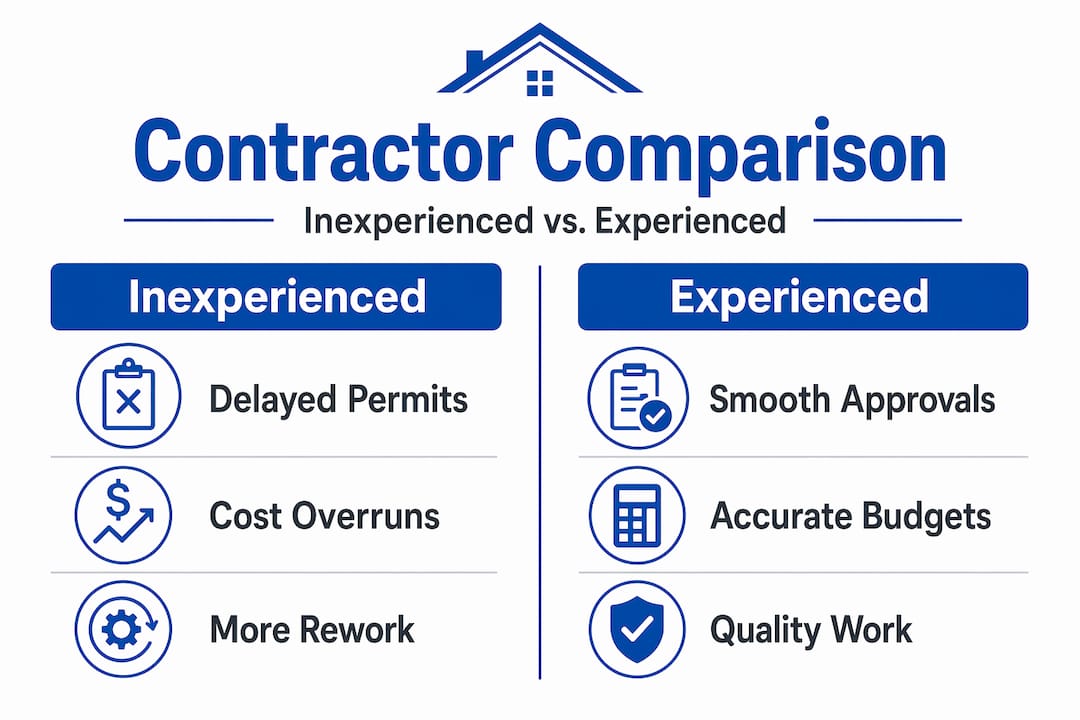
Inexperienced vs. experienced contractors: what you actually get
The importance of contractor experience becomes clearest when you compare outcomes side by side. It’s not just about years in business. It’s about the depth of knowledge that shapes every decision on your project.
Experienced contractors bring material knowledge that directly affects quality. They know which products perform in specific climates, which finishes hold up in commercial environments, and where to avoid common wood flooring errors that lead to costly repairs down the line. That kind of material fluency means fewer substitutions, fewer callbacks, and a finished product that holds up the way it was designed to.
Value engineering is another capability that only comes with experience. When a specified material is backordered or a detail is over-budget, an experienced contractor can propose an alternative that preserves the design intent without compromising quality. An inexperienced contractor either stalls or makes a substitution without fully understanding the trade-offs.
Licensed contractors also bring regulatory compliance as a baseline. They understand building codes, safety standards, and liability requirements. That reduces your exposure as a property owner and keeps the project on the right side of inspections.
Key advantages experienced contractors deliver:
- They can look at completed subcontractor work and identify quality issues before they become problems
- They bring trade knowledge from self-performing work, so they understand what proper installation actually looks like
- They use structured communication tools that keep owners informed without requiring constant check-ins
- They understand utility sourcing, land zoning, and permit processing from direct experience, not from asking someone else
My take on what experience actually means in the field
I’ve seen the difference that experience makes play out on real projects, and it rarely shows up where people expect it. Most owners think experience means fewer mistakes. That’s true, but it’s not the whole picture. What experience really means is that when something unexpected happens, and it always does, the response is fast, informed, and doesn’t cost the owner twice.
The most valuable thing I’ve learned is that experienced contractors can read work. When a licensed general contractor walks a site and looks at what a subcontractor has done, they know immediately whether it’s right. Not from a checklist. From having done that work themselves or supervised it hundreds of times. That ability to spot imperfections before they get buried behind drywall or under flooring is something you simply cannot buy with a lower bid.
What I find most overlooked is the back-end knowledge. Permit processing, land zoning, utility sourcing, professional networks for specialized questions. These aren’t glamorous, but they’re what keeps a project moving when everyone else is waiting. I’ve watched projects stall for weeks because the contractor didn’t know who to call or how to frame a request to a city planning office. That’s avoidable with experience.
The communication side matters just as much. Using a CRM like Job Tread changes how information flows between the owner, the contractor, and every subcontractor on the job. Everyone sees the same timeline, the same budget updates, and the same documentation. That transparency doesn’t just feel better. It prevents the miscommunications that turn into disputes.
— Kaidden
Work with a team that brings real experience to your project
When the stakes are high on a custom home or commercial build, you need more than a contractor who shows up and figures it out. Travislarsenconstruction has three licensed general contractors on staff, bringing deep expertise in value engineering, quality control, and the kind of problem-solving that only comes from years of hands-on experience. The team uses
Job Tread for client communication, giving property owners and developers real-time visibility into timelines, budgets, and subcontractor coordination.
From high-end custom homes to commercial tenant improvements, ground up commercial projects and business remodels, Travis Larsen Construction delivers the quality and efficiency that experienced general contractors make possible. If you’re planning a project and want a team that knows the difference between good work and great work, Contact Travis Larsen Construction to start the conversation.
FAQ
Why does contractor experience matter for custom home projects?
Experienced contractors bring material knowledge, trade expertise, and QA/QC systems that prevent costly rework and keep projects on schedule. For high-end custom homes, those capabilities directly affect both quality and final cost.
How does contractor experience reduce project costs?
Experienced contractors manage the top cost risk factors including material escalation, change orders, and estimating gaps by applying procurement planning and structured change order governance that less experienced teams typically lack.
What should I ask a contractor to assess their experience?
Ask how they track defects during construction, how they handled a major design change on a past project, and what project management tools they use. Specific, detailed answers indicate genuine experience.
How does contractor experience affect permit and approval timelines?
Approval bottlenecks can add 28 days per critical decision on complex projects. Experienced contractors know local permit processes, maintain proper documentation, and sequence submissions to prevent one approval from stalling the entire schedule.
Does licensing matter as much as years of experience?
Both matter together. Licensed contractors meet baseline code and safety compliance requirements, while years of field experience add the judgment, material knowledge, and problem-solving depth that licensing alone does not guarantee.
Recommended

 Design changes are another area where experience pays off. Owners change their minds. Architects revise drawings. Engineers catch something in the field. These things happen on every project. What separates a seasoned contractor is the ability to minimize scope ambiguity upfront, structure change order documentation carefully, and sequence work so that one change doesn’t cascade into three additional delays. An inexperienced contractor often lets change orders pile up informally, then presents the owner with a surprise invoice at the end.
Here’s how experienced contractors manage the top five cost risks in sequence:
Design changes are another area where experience pays off. Owners change their minds. Architects revise drawings. Engineers catch something in the field. These things happen on every project. What separates a seasoned contractor is the ability to minimize scope ambiguity upfront, structure change order documentation carefully, and sequence work so that one change doesn’t cascade into three additional delays. An inexperienced contractor often lets change orders pile up informally, then presents the owner with a surprise invoice at the end.
Here’s how experienced contractors manage the top five cost risks in sequence:
 Value engineering is another capability that only comes with experience. When a specified material is backordered or a detail is over-budget, an experienced contractor can propose an alternative that preserves the design intent without compromising quality. An inexperienced contractor either stalls or makes a substitution without fully understanding the trade-offs.
Licensed contractors also bring regulatory compliance as a baseline. They understand building codes, safety standards, and liability requirements. That reduces your exposure as a property owner and keeps the project on the right side of inspections.
Key advantages experienced contractors deliver:
Value engineering is another capability that only comes with experience. When a specified material is backordered or a detail is over-budget, an experienced contractor can propose an alternative that preserves the design intent without compromising quality. An inexperienced contractor either stalls or makes a substitution without fully understanding the trade-offs.
Licensed contractors also bring regulatory compliance as a baseline. They understand building codes, safety standards, and liability requirements. That reduces your exposure as a property owner and keeps the project on the right side of inspections.
Key advantages experienced contractors deliver:
 From high-end custom homes to commercial tenant improvements, ground up commercial projects and business remodels, Travis Larsen Construction delivers the quality and efficiency that experienced general contractors make possible. If you’re planning a project and want a team that knows the difference between good work and great work, Contact Travis Larsen Construction to start the conversation.